
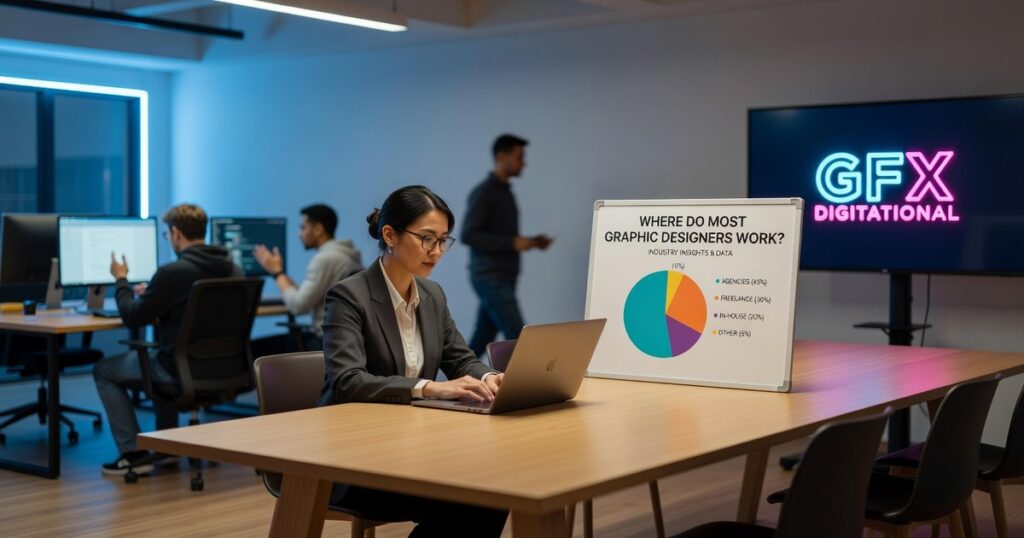
I’ve been tracking digital design careers for years, and one question keeps coming up: where do most graphic designers actually work?
You’re probably wondering the same thing. Maybe you’re considering a career switch or just finished design school. The job market looks crowded and confusing from the outside.
Here’s the reality: digital design jobs exist in more places than you think. But they’re not all created equal.
I pulled data from thousands of current job postings to figure out where do most graphic designers work gfxdigitational. Not where they worked five years ago. Where they’re working right now.
This guide maps out the main career paths available to you. I’ll walk you through corporate design teams, agencies, startups, and freelance work. What each one actually looks like day to day.
The demand for digital designers is higher than it’s ever been. But that doesn’t mean every opportunity is worth your time.
You’ll see which environments pay better, which ones offer more creative freedom, and which ones are best for building specific skills.
No fluff about following your passion. Just a clear breakdown of where the jobs are and what they require.
The Corporate Path: Working In-House for a Single Brand
Let me tell you what most articles about in-house design jobs won’t admit.
They make it sound like you’re just pushing pixels for one logo all day.
That’s not how it actually works.
An in-house designer is a full-time employee who handles all the design needs for a single company. You’re not juggling five clients or pitching new business every month. You work for one brand and you get really good at understanding what they need.
Where do most graphic designers work? The answer might surprise you. Tech companies (think SaaS platforms and consumer electronics) hire the most in-house designers. E-commerce and retail come next. Then you’ve got finance (FinTech especially) and healthcare rounding out the top spots.
But here’s what nobody talks about.
Some people say in-house work is boring. They’ll tell you it’s the same thing every day and you’ll lose your creative edge. I’ve heard this argument a hundred times from agency folks who think variety equals growth.
They’re missing something big though.
Your day-to-day looks like this. You create marketing collateral (social media graphics, email newsletters, ad banners). You keep the brand consistent across every digital platform. You design user interfaces for websites or internal tools. And you work closely with marketing and product teams who actually care about what you’re building.
The stability is real. So is the deep brand knowledge you develop. When you spend months or years with one company, you understand their audience in ways freelancers never will.
The predictable workflow means you can actually plan your life. No late-night client emergencies because someone changed their mind about a color.
The downside? Less creative variety compared to gfxdigitational agency work or freelancing. You’re solving problems within one brand’s guardrails.
But that constraint? It can make you sharper than you’d expect.
The Agency World: A Hub of Variety and Velocity
You know what nobody tells you about agency life?
It’s chaos wrapped in a pitch deck.
I’m talking about those third-party firms that handle creative and design services for multiple clients at once. Full-service digital marketing agencies. Specialized branding studios. Web design shops. Advertising agencies that promise the moon.
They all operate the same way. Fast. Really fast.
What You’re Actually Signing Up For
Here’s the reality. You’ll juggle five client projects on a Tuesday and seven by Thursday. One minute you’re developing a brand identity from scratch for a startup. The next you’re tweaking campaign assets for a corporate client who changed their mind (again). In the fast-paced world of digital marketing, where you might shift from creating a unique brand identity for a startup to revising campaign materials for a demanding corporate client, the innovative tools and resources offered by Gfxdigitational can be a game-changer for managing your creative workload. In the ever-evolving landscape of digital marketing, mastering the art of multitasking has become essential for professionals like us, where the ability to seamlessly transition between diverse projects is as vital as the innovative strategies offered by platforms such as Gfxdigitational.
The team setup sounds great on paper. Copywriters, strategists, other designers all collaborating together. And sometimes it is great.
But let’s talk about what drives me crazy.
The deadlines. They’re always tight. Always. A client decides they need a complete rebrand in two weeks because their launch date got moved up. Guess who’s working late?
And the feedback loops. You present three concepts. The client picks elements from all three and asks you to “combine them.” Which is like asking someone to merge a sports car with a minivan and a motorcycle.
Then there’s the classic move where stakeholders who weren’t in the original meetings suddenly appear with opinions. Strong ones. About fonts.
But here’s what I can’t deny.
You learn fast in agencies. Where do most graphic designers work gfxdigitational? Many start in agencies because the exposure is unmatched. You’ll work across industries you never considered. Healthcare one week, fintech the next, then a restaurant chain.
Your skills grow whether you’re ready or not.
The pressure either breaks you or makes you incredibly efficient. There’s no middle ground. You figure out shortcuts, master your tools, and learn to present ideas that stick.
Just don’t expect work-life balance in your first year.
The Startup Ecosystem: Designing and Building from the Ground Up

Working for a startup means you’re joining a young company that’s growing fast. Usually in tech.
Your job? It’s not just one thing.
You’ll design the product itself (the app interface, the user experience). Then you’ll switch gears and create marketing materials. Pitch decks for investors. The website. Social media graphics. All of it.
This is where how to learn graphic design for free gfxdigitational becomes really useful. You need a broad skill set because you’re building the brand’s visual identity from scratch.
Here’s what you gain from this environment.
You get real ownership. Your designs don’t just look pretty. They shape how people see the entire company. That’s the kind of impact most designers wait years to have.
The culture moves fast. Startups use agile methods, which means you’re not waiting weeks for approval on every decision. You have autonomy. You make calls. You contribute to strategy, not just aesthetics.
Some people say where do most graphic designers work gfxdigitational, and startups aren’t usually the first answer. But that’s changing.
Now for the reality check.
The structure is loose. Sometimes nonexistent. You’ll wear multiple hats (and not always by choice). Your job security depends on whether the company gets funding and keeps growing.
But if you want to build something from nothing? If you want your work to matter right away instead of getting lost in some corporate approval chain?
This is your spot.
The Independent Route: Freelancing and Contracting
Let me be straight with you.
Freelancing isn’t for everyone. But if you value control over your time and the projects you take on, this path might be worth considering.
Here’s what freelancing actually means. You work for yourself. You find clients, negotiate rates, deliver work, and get paid. Simple in theory. Harder in practice. Navigating the complexities of freelancing can be daunting, but staying updated with insights like those found in Gfxdigitational Tech News by Gfxmaker can provide invaluable guidance for aspiring independent creators. Staying informed about industry trends and tools through resources like Gfxdigitational Tech News by Gfxmaker can significantly empower freelancers to navigate their unique challenges with greater confidence and skill.
Finding Your First Clients
Most designers start on platforms like Upwork or Toptal. These sites connect you with people who need design work. The catch? You’re competing with hundreds of other designers, many charging rates you probably can’t match.
My recommendation? Use these platforms to build your portfolio, but don’t stay there long. Direct client relationships pay better and give you more creative freedom.
Where do most graphic designers work gfxdigitational tech news by gfxmaker covers this extensively, but the short answer is wherever they want. That’s the whole point of going independent.
What You’ll Actually Do
Freelance projects vary wildly. One week you might design a logo for a startup. The next, you could be embedded with a tech company for six months, working like you’re on staff but without the benefits.
| Project Type | Duration | Income Stability |
|————–|———-|——————|
| One-off jobs | Days to weeks | Unpredictable |
| Retainer clients | Ongoing monthly | More stable |
| Contract roles | 3-6 months | Steady during contract |
The Real Trade-offs
You get flexibility. You choose your hours, your clients, your rates (within reason). You can work from O’Fallon or Bali. Nobody tells you what to do.
But you also become the marketing department, sales team, accountant, and customer service rep. All while doing the actual design work.
And the income? It fluctuates. A lot.
Some months you’ll make more than you ever did at a job. Other months you’ll wonder if you should’ve stayed employed. This is normal. Plan for it.
My Take
Start freelancing while you still have a job if possible. Build your client base slowly. Once you have three solid clients who pay regularly, you can think about going full-time independent.
Don’t quit your job on Monday and expect to replace your income by Friday. That’s not how this works.
Niche and Specialized Employment Settings
Most people think graphic design jobs are all about agencies and tech companies.
But that’s only part of the picture.
I’ve seen designers build entire careers in spaces most people never consider. Places where your skills matter just as much but the work looks completely different.
Education and EdTech is one of those spaces. You’re designing learning materials and course interfaces that actually help people learn. Universities need you. Online platforms need you. And if you’ve ever wondered where do most graphic designers work gfxdigitational covers this, it’s often in these quieter sectors that don’t make headlines.
Then there’s government and non-profit work. Public communications and campaign materials that serve real causes. The pay might surprise you (in a good way) and the benefits are usually solid.
Entertainment and media pulls you into motion graphics for streaming services or promotional work for gaming studios. It’s fast-paced and the projects actually end up in front of millions of people. As the demand for captivating visual content in the gaming industry skyrockets, aspiring designers can take advantage of resources like “How to Learn Graphic Design for Free Gfxdigitational” to hone their skills and contribute to projects that reach millions. As the demand for captivating visual content in the gaming industry skyrockets, aspiring designers can explore invaluable resources such as “How to Learn Graphic Design for Free Gfxdigitational” to hone their skills and create stunning motion graphics that resonate with audiences worldwide.
Publishing has gone almost entirely digital now. E-books and online magazines need designers who understand how people read on screens.
Here’s what you’re probably asking yourself next: which of these pays best? And which one actually has openings right now?
Choosing the Right Digital Design Environment for You
You’ve seen the options now.
Digital designers work in-house at stable companies. They join fast-paced agencies. They take risks at startups or go freelance for flexibility.
The real question isn’t where can you work. It’s where should you work.
Finding opportunities is easy. Finding the right fit takes more thought.
Each environment has its own rhythm and culture. In-house teams offer predictability. Agencies throw variety at you daily. Startups let you shape the product. Freelancing gives you control over everything (including when you get paid).
You need to match your work style to the setting.
Do you want stability or do you crave change? Are you building toward leadership or protecting your creative freedom? These answers matter more than the job title.
Here’s what to do next: Write down your top three priorities. Maybe it’s work-life balance. Maybe it’s portfolio diversity. Maybe it’s earning potential.
Your priorities will point you toward where do most graphic designers work gfxdigitational and where you’ll actually thrive.
Target your portfolio to that environment. Tailor your applications. Be honest about what you need from a role.
The right environment doesn’t just employ you. It helps you grow into the designer you want to become. Homepage.