I’ve been working in digital design long enough to know that most “breaking news” is just repackaged marketing.
You’re here because you need to know what actually matters. Not what some tech blog says you should care about, but what will change how you work.
Here’s the reality: new tools drop every week. AI updates flood your feed. Hardware announcements promise to revolutionize everything. Most of it won’t affect your workflow at all.
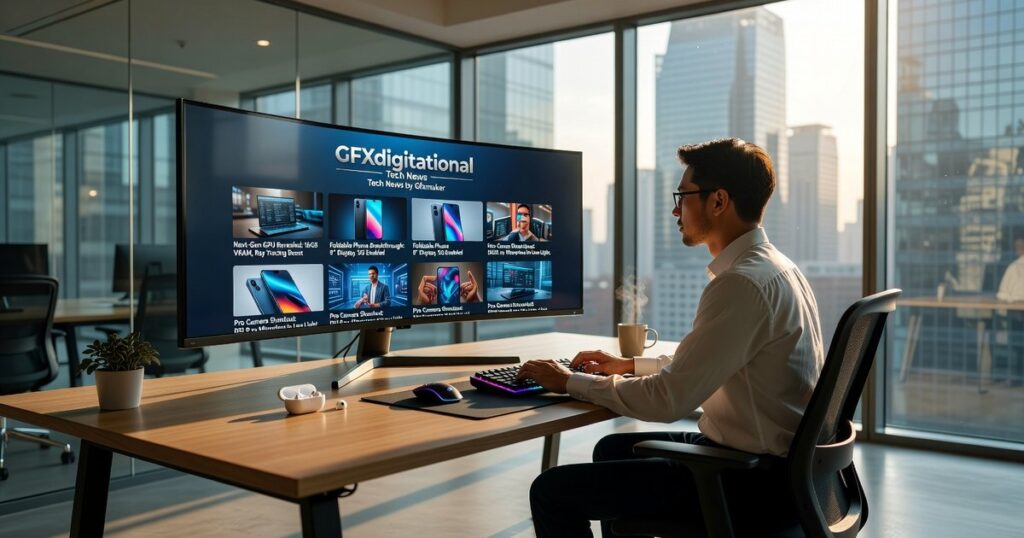
I filter through this noise daily at gfxdigitational tech news by gfxmaker. I test the software. I watch how professionals actually use new features (not how companies say we should use them). I separate the tools that save time from the ones that waste it.
This article cuts straight to what’s happening right now in digital design and graphics. The software updates that matter. The hardware worth considering. The AI developments that are actually changing how we create.
You’ll get a clear picture of which tech shifts deserve your attention and which ones you can ignore.
No hype. No speculation about what might happen next year.
Just what’s working today for people who make their living creating digital art.
The AI Co-Pilot: Integrating Artificial Intelligence into Your Workflow
Look, I’m tired of the AI debate.
You know the one. Where half the design community acts like AI is going to replace us all, and the other half pretends it doesn’t exist.
Both sides are missing the point.
I’ve been using AI tools in my workflow for over a year now. Not because I’m trying to cut corners. Because I’m tired of spending three hours removing backgrounds when I could be doing actual creative work.
Generative AI for Ideation, Not Finalization
Here’s what drives me crazy about how people talk about Midjourney and Stable Diffusion.
They either treat these tools like magic buttons that spit out finished work, or they dismiss them completely as “not real art.” Neither approach makes sense if you’re actually trying to get work done.
I use generative AI for mood boarding. For exploring concepts I wouldn’t have thought of on my own. For getting past that blank canvas moment that can eat up half your morning.
But here’s the thing that gfxdigitational tech news by gfxmaker keeps getting right in their coverage. These tools work best when you treat them like what they are: starting points.
The final touch? That’s still on you.
Smarter Software, Faster Results
Adobe’s Generative Fill changed how I work. Not because it’s perfect (it’s not), but because it handles the tedious stuff that used to kill my momentum.
Object removal used to mean careful cloning and hours of cleanup. Now it takes minutes.
Topaz Labs’ upscaling lets me salvage client assets that would’ve been unusable before. You know those low-res logos clients swear are “high quality”? Yeah, those.
The frustrating part? Watching designers waste time on manual masking because they’re too proud to try AI-powered selection tools. I get wanting to do things the “right way,” but spending two hours on something software can do in thirty seconds isn’t noble. It’s just inefficient.
Navigating the Ethical Landscape
This is where it gets complicated.
I won’t lie to clients about using AI tools. That feels wrong, and honestly, it’s just bad business. When something goes sideways (and it will), you want a clear record of your process.
Copyright is messy right now. The training data issues aren’t resolved. I don’t have all the answers, and anyone who says they do is probably selling something.
What I do know is this: you need to understand where your AI tools get their data. You need to tell clients when AI played a role in their project. And you need to stay on top of how this stuff is changing because it’s moving fast. In an era where the impact of AI on creative projects is undeniable, understanding the role of platforms like Gfxdigitational is crucial for both transparency with clients and staying ahead in the rapidly evolving digital landscape. In an era where the impact of AI on creative projects is undeniable, staying informed about tools like Gfxdigitational not only enhances your workflow but also ensures transparency with clients regarding the role of AI in shaping their vision.
Is it annoying to add another layer of disclosure to client work? Sure. But it beats getting caught in a legal mess later.
The Software Arena: Key Updates and Emerging Challengers
The subscription model isn’t going anywhere.
But here’s what’s changed. More designers are pushing back on the idea that you have to rent your tools forever.
I’m seeing a real shift. People want options that don’t come with monthly bills attached to their creative work.
Now, some will tell you that subscriptions are the only way software companies can stay competitive. They’ll say perpetual licenses mean slower updates and less support. And sure, there’s some truth there.
But that argument ignores what’s actually happening.
Tools like Affinity V2 Suite prove you can get professional results without the recurring cost. You pay once and the software is yours. Same goes for Procreate Dreams on iPad. These aren’t budget alternatives anymore. They’re legitimate choices for serious work.
Let me break down what matters right now.
Adobe Creative Cloud still dominates. That’s just reality. But the Substance suite added 3D features that change how where do most graphic designers work gfxdigitational and what tools they need. We’re talking about texture work that used to require multiple programs.
Procreate recently added vector-based text editing. Sounds small but it’s not. It means you can finally handle typography properly without jumping to another app.
Then there’s the collaboration angle.
Figma changed everything when it came to real-time teamwork. You and three other people can work on the same file at once. No version conflicts. No emailing files back and forth.
Spline took that same idea and applied it to 3D design. Browser-based. Cloud-saved. Multiple people working together like it’s a Google Doc.
This is where things get interesting for gfxdigitational tech news by gfxmaker coverage. These collaborative tools are setting new standards. Even traditional software has to respond. Designers expect to work from anywhere now. They expect their files in the cloud. They expect to share work instantly.
The software landscape isn’t just about features anymore. It’s about how you work and who you work with.
Hardware That Empowers: Processors, Displays, and Peripherals
You know that moment when you’re working on a complex design and your computer just freezes?
Yeah, I used to deal with that constantly.
Here’s what changed. Modern processors actually keep up with what we do now.
Take Apple’s M-series chips or AMD’s Ryzen processors. They handle massive Photoshop files without breaking a sweat. Your render times drop from minutes to seconds. And you can run Illustrator, Premiere, and After Effects at the same time without your machine sounding like it’s about to launch into space.
That’s not just convenience. That’s the difference between finishing a project today or tomorrow.
But processing power only gets you halfway there.
You Can’t Design What You Can’t See

I’ll be honest. I worked on a cheap monitor for years thinking it didn’t matter.
It mattered.
Professional displays have become way more accessible than they used to be. You don’t need to drop five grand anymore to see accurate colors. As professional displays become increasingly accessible, the insights from the Gfxdigitational Tech Guide From Gfxmaker can help gamers and creators alike choose the right monitors to achieve stunningly accurate colors without breaking the bank. As professional displays become increasingly accessible, leveraging the insights from the Gfxdigitational Tech Guide From Gfxmaker empowers both gamers and creators to achieve stunning visual fidelity without breaking the bank.
What you do need to look for is pretty specific. High refresh rates make your pen input feel natural instead of laggy. Wide color gamut coverage (DCI-P3 or Adobe RGB) means what you see on screen matches what prints or displays elsewhere. HDR capabilities give you better contrast and detail in your work.
The gfxdigitational tech guide from gfxmaker covers display specs in more depth if you want to dig into the technical side.
The Evolving Digital Canvas
Drawing tablets have gotten seriously good.
Pen pressure sensitivity now reaches 8,192 levels on most decent tablets. That means your strokes respond exactly how you want them to. Parallax (that annoying gap between where your pen touches and where the line appears) has shrunk to almost nothing on newer pen displays.
And here’s something I didn’t expect. Mobile setups like the iPad Pro have become legitimate professional tools. Not just for sketching ideas. For actual client work.
You can run full projects on a tablet now and nobody will know the difference in your final output.
On the Horizon: Future-Forward Skills and Technologies
The line between 2D and 3D work is disappearing.
I’m not saying you need to become a full-time 3D artist. But if you’re still avoiding Blender or Cinema 4D, you’re making things harder on yourself.
Here’s why.
Clients expect depth now. They want illustrations with realistic lighting. Motion graphics that feel tangible. Product mockups that look like photographs.
You can fake some of this in Photoshop. But honestly? Learning basic 3D modeling saves you hours and opens up work you couldn’t touch before.
Some designers push back on this. They say 2D is pure art and 3D is just technical work. That keeping your focus narrow makes you better at what you do.
I hear them. But what happens when the client asks for a 360-degree product view? Or wants their logo animated in three-dimensional space?
You either learn it or you pass on the job.
Real-time rendering changed everything.
Unreal Engine 5 isn’t just for game developers anymore. I’m seeing it pop up in product visualization, virtual production studios, and interactive brand experiences.
The wild part? You don’t need a computer science degree to use it. The barrier to entry keeps dropping.
What about AR?
Meta Spark and Snap’s Lens Studio are creating demand for designers who can build filters and interactive assets. Brands want custom AR experiences. They want their products in people’s hands (virtually) before purchase.
This isn’t some distant future thing. Companies are hiring for this right now.
You might be wondering what to learn first. Or if you even have time to add new skills.
Fair questions. Start with what connects to your current work. If you do product design, try Blender for mockups. If you’re in branding, experiment with AR filters. In exploring the various tools and platforms that can enhance your design skills, it’s essential to consider the question, “Where Do Most Graphic Designers Work Gfxdigitational,” as it can provide valuable insights into the environments that foster creativity and innovation in the industry. In the quest to elevate your design skills, understanding the environment and context of your craft becomes vital, leading to the pertinent inquiry, “Where Do Most Graphic Designers Work Gfxdigitational,” as this can influence the tools and platforms you choose to explore.
You can find most of this covered in gfxdigitational tech news by gfxmaker if you want to track how these tools are actually being used.
The point isn’t to master everything. It’s to stay aware of where the work is going.
Adaptability is the Ultimate Skill
We’ve covered a lot of ground here.
You came looking for clarity in the tech news chaos. Now you have it. The trends that matter are practical AI integration, the shifting software landscape, and hardware that gets out of your way so you can create.
Here’s the truth though: the tools will keep changing. They always do.
What doesn’t change? Good design principles. Strong storytelling. Real creativity.
Those are your foundation. Everything else is just a means to express them better.
You don’t need to chase every new release or master every platform. That’s exhausting and it misses the point.
Stay curious instead. Pay attention to what’s happening. Then ask yourself which innovations actually serve your work and make you more efficient.
Some will. Most won’t.
The ones that do? Adopt them strategically. Test them against your artistic vision and see if they hold up.
Change isn’t something to fear. It’s how you grow.
gfxdigitational tech news by gfxmaker exists to help you separate signal from noise. We track the innovations that matter so you can focus on creating work that stands out.
Your next step is simple: take what you’ve learned here and apply it to your next project. Pick one trend that resonates with your goals and experiment with it.
The future belongs to creators who adapt without losing sight of what makes their work meaningful. Homepage.